What to do after your product launch: a 90-day B2B pipeline checklist
Key takeaways
- Treat launch week as research: sign-ups, feedback and activations show who your real buyers are.
- Follow up only with people who signed up or opted in; never scrape profiles or cold-message people who reacted to your launch.
- Write the ICP from who actually activated, not from who paid attention on launch day.
- Set up email authentication and CRM source tracking before outbound volume grows.
- A repeatable pipeline comes from a weekly engine, not from the next launch.
What should you do after your product launch?
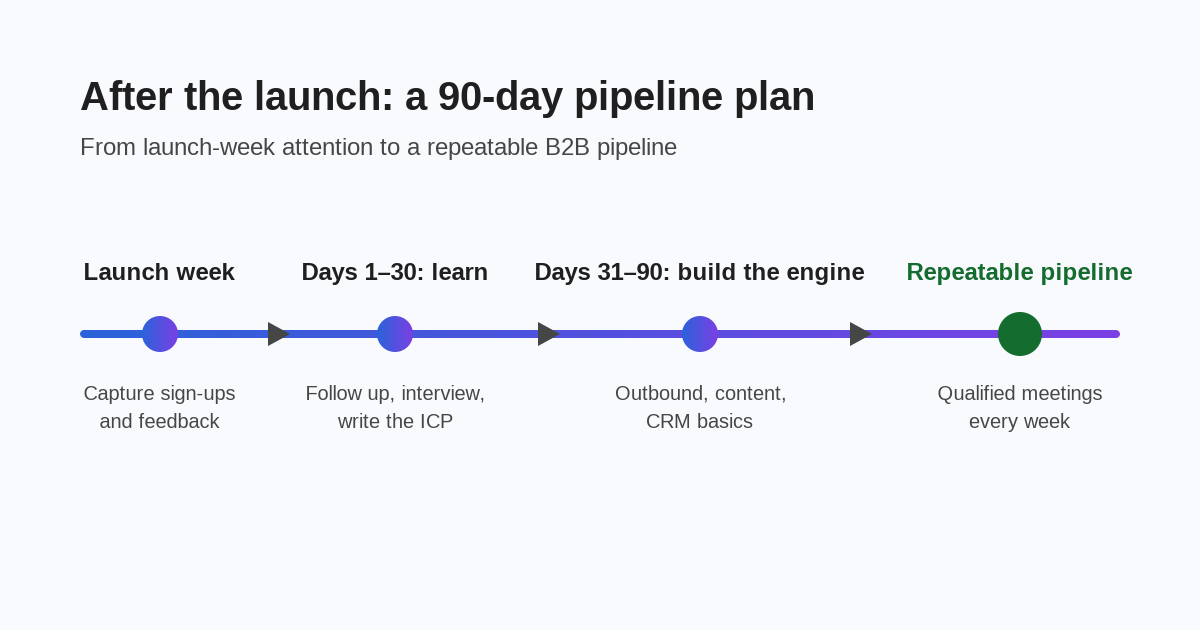
After your product launch, spend the first 30 days learning who your real buyers are and the next 60 building a weekly pipeline engine. Launch week gives you attention and raw material; the 90 days after it decide whether any of that turns into revenue.
Most founders feel the pull to do more launching: another post, another directory, another round of social updates. That rarely helps a B2B product. What helps is following up with the people who signed up, finding out which of them are real buyers, and building outbound, content and CRM basics around that group.
This checklist is the order we follow with newly launched B2B software companies. If you want help running it, our page for founders who have just launched explains how we work with teams at this stage.
Why doesn’t launch traffic turn into pipeline on its own?
Launch traffic does not turn into pipeline on its own because most of it comes from people who are interested in launches, not from people with a budget and a problem your product solves. A launch rewards novelty; a B2B purchase rewards fit, timing and trust.
In our experience, the attention fades within days. The visitors in launch week are a mix of other builders, investors, founders, students and a smaller group of genuine prospects, and the analytics dashboard does not tell you which is which. Even the genuine prospects usually need more than one touch, and a conversation with the other people who sign off on a purchase, before they buy.
The table below shows the difference between what a launch gives you and what a repeatable pipeline needs.
| Factor | Launch traffic | Repeatable pipeline |
|---|---|---|
| Where it comes from | One event, on one day | Several channels that run every week |
| Who arrives | A broad mix of curious visitors, peers and some buyers | Accounts chosen because they fit your ICP |
| Timing | A spike that fades quickly | Steady, and planned in advance |
| What it tells you | Which ideas and messages catch attention | Which segments buy and which messages book meetings |
| What you control | Little after the day itself | Lists, messages, volume and follow-up |
| What it needs to work | A good story and a clear product page | A written ICP, outbound, content and a clean CRM |
The launch is still valuable. It just plays a different role: it is the best research moment you will get for months, and it gives you proof you can use later.
What should you do in launch week?
In launch week, capture everything you will need for the next 90 days, because some of it disappears quickly. The goal is a clean record of who signed up, what they said and why.
- Make sure every sign-up is recorded with a source, so you can tell launch sign-ups from the rest later.
- Save the most useful comments and questions, word for word. They show how people describe the problem in their own language.
- Note which features people asked about and which objections came up more than once.
- Write a short founder story: why you built the product, who it is for and what changed after the first users tried it.
- Reply to every comment and question yourself. That is good manners, and it also keeps the conversation where it started, in public, rather than in someone’s inbox uninvited.
None of this needs a large team or new tools. A founder, a shared document and a CRM with a source field are enough. What matters is doing it during launch week, while the comments are fresh and the sign-ups still remember why they clicked. A week later, the same work takes longer and teaches you less, because the context behind each sign-up has already faded.
What should you do in days 1–30?
In days 1 to 30, follow up with sign-ups, interview the ones who activated and turn what you learn into a first ideal customer profile. Resist scaling anything until the ICP is written down.
Use the first half of the step-by-step checklist below for this phase:
- Follow up with every sign-up. Send a short, plain-text note from a founder, not a newsletter. Ask one question: what made you sign up? Honour every opt-out straight away.
- Tag each sign-up in your CRM. Record company, role, company size, use case, source and whether the person activated. A sign-up without a company name is hard to learn from, so look the company up where you can.
- Interview early users. Book short calls with people who reached real value, and with a few who signed up and stopped. Ask about the problem, what they used before and who else would need to approve a purchase.
- Group sign-ups by fit. Sort sign-ups into likely buyers, peers and the merely curious. Be honest: a large group of other founders who liked the product is encouraging, but those founders are rarely your buyers.
- Write the first ICP. Describe the companies and roles that activated and fit your pricing. Include the events that seemed to trigger interest, and list the segments you will not target.
- Fix your site for search and AI citation. Rewrite the home page and key pages so the first paragraph says what the product is, who it is for and what it solves. Add an FAQ in your buyers’ words. Clear, quotable answers are the base of answer engine optimization.
- Collect proof. Ask happy early users whether you can quote them by name and role. Save the launch announcement and the founder story as public proof of where the product started.
What should you do in days 31–90?
In days 31 to 90, build the parts of the engine that produce qualified meetings every week: outbound, content and CRM basics. Each part should come from the ICP you wrote in the first month.
- Set up email authentication before outbound. Google’s email sender guidelines ask bulk senders to authenticate mail with SPF, DKIM and DMARC, keep spam rates low and offer one-click unsubscribe for marketing messages. Send cold email from a secondary domain, warm new inboxes up gradually and read our glossary entry on email deliverability before the first send.
- Start signal-based outbound in small batches. Choose a few events that connect to the problem you solve, such as a relevant hire or a change in tools, and contact ICP accounts that show them. Our guide to signal-based outbound covers list building step by step, and signal-based selling explains the idea behind it.
- Have a person approve every sequence. AI is useful for research and first drafts. A founder or senior seller should still check every claim and every first line before anything sends.
- Publish answers to the questions you heard. Turn the interview notes into pages and posts that answer real buyer questions in plain language. Answer-first pages are what search engines and AI assistants tend to quote.
- Set up CRM basics. Define lifecycle stages, route new leads to an owner and record the source of every meeting and opportunity.
- Review every two weeks. Look at which segments reply, which messages book meetings and which channels produce opportunities. Cut what does not work and do more of what does.
- Write the playbook down. By day 90, document the ICP, the signals, the sequences and the reporting, so the engine keeps running when the founder is busy with deals.
If you want a team to run these steps with you, our GTM strategy and ICP design work covers steps 1 to 7, and our AI outbound service covers steps 8 to 10.
Can you email everyone who showed interest during your launch?
You should not treat everyone who liked, shared or commented on your launch as a cold email list. A public reaction to a launch is not permission to be contacted, and scraping profiles or messaging people through a community or social platform is a fast way to lose the goodwill the launch built.
We do not scrape launch pages or social profiles, or message people through those platforms, and we advise clients not to either. The people you can follow up with are the ones who signed up for your product, joined your waitlist or otherwise opted in to hear from you. Public comments are still useful: read them as research into how buyers talk about the problem, and use that language in your ICP and messaging.
When you do send commercial email, the law applies to B2B email too. The FTC’s CAN-SPAM compliance guide states that the Act covers business-to-business email, and that commercial messages must not use misleading headers or subject lines, must include a valid postal address and must give recipients a clear way to opt out, with opt-outs honoured promptly. If you are writing to people in the UK or EU, PECR and GDPR also apply, and the rules differ from the US. Check each market with your own counsel before you start.
How do you know the post-launch plan is working?
The post-launch plan is working when qualified meetings come from accounts that match your written ICP, and you can trace each meeting to a channel and a message. Sign-up counts and page views say little about pipeline.
Look for three things by the end of the 90 days. First, a written ICP that your team agrees with and uses to say no to poor-fit accounts. Second, at least one channel, such as outbound or content, that produces qualified conversations week after week without a launch behind it. Third, a CRM that shows where every opportunity came from, so the next quarter’s budget goes to what works.
If one of those is missing, fix that before adding channels. Adding a second channel on top of an unclear ICP only spreads the same problem across more places. A repeatable pipeline is less exciting than a launch day, and it is the part that pays for the next one.
Sources
Questions buyers ask us
Frequently asked questions
What is the first thing to do after a product launch?
Follow up personally with everyone who signed up, while the launch is still fresh in their minds. Ask what made them try the product and what they hoped it would do. Record each answer in a CRM against the sign-up, because those answers are the start of your ICP.
Can we email everyone who showed interest during our launch?
Not as a cold list. A like, comment or visit is not consent to be emailed, and scraping profiles or messaging people through a community or social platform breaks the trust the launch built and may break that platform's terms. Email people who signed up or opted in, and use public comments as research into how buyers describe the problem.
How long should we wait before starting outbound after launch?
Wait until you have a written ICP based on who activated, not just who signed up. For most teams that means a few weeks of interviews and sign-up analysis first. Use that time to set up and authenticate sending domains, so the first campaign is not held up by technical work.
Is a public launch worth it for a B2B product?
A launch can be worth it for the feedback, the early sign-ups and the public story, as long as you do not expect it to replace a go-to-market. The value depends on what you do in the weeks after it. Plan the follow-up before the launch, not after.
What should we measure in the 90 days after launch?
Measure qualified meetings, opportunities and the source of each one, rather than total sign-ups or page views. Track which ICP segments activate and which messages draw replies from the right buyers. Those numbers tell you where to put the next quarter's budget.
About Meera Bay
Marketer
Meera Bay is a marketer at GetGTM. She writes and edits the GetGTM blog, covering go-to-market strategy, outbound, RevOps and AI search for newly launched B2B startups.