Signal-based outbound: how to build B2B prospect lists that respond
Key takeaways
- Signal-based outbound targets accounts showing a reason to buy now, not just accounts that fit your ICP.
- A signal is only useful if it connects to a problem your product solves and you can name it in the first line of the email.
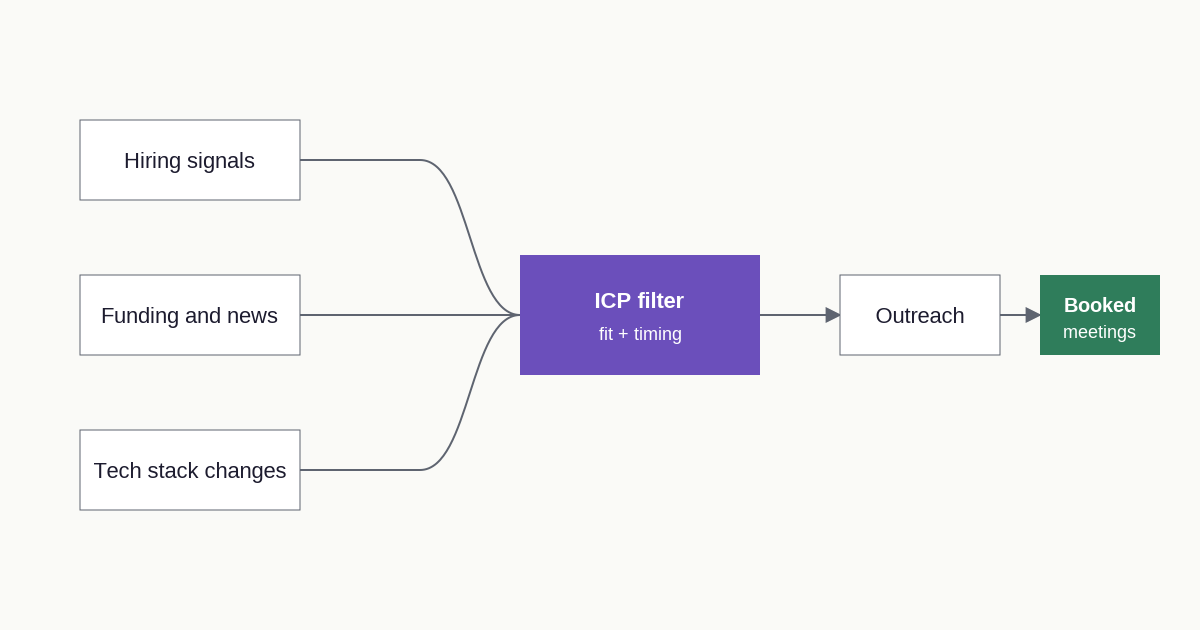
- Combine fit and timing: score accounts on ICP fit first, then rank them by recent signals.
- Deliverability set-up (SPF, DKIM, DMARC, one-click unsubscribe) comes before any copy or list work.
- Use AI to research signals and draft first lines; a human approves every sequence before it sends.
What is signal-based outbound?
Signal-based outbound is a prospecting method that contacts B2B accounts when an observable event suggests they have a need right now. That event, called a buying signal, might be a new VP of Sales, a funding round, a job post for a role your product supports, or a move away from a competitor’s tool. The signal decides who goes on your list this week, and it gives the first line of your email a real reason to exist.
Traditional outbound starts from a static list: every company in a segment that matches your ideal customer profile, exported once and worked through in order. Signal-based outbound keeps the ideal customer profile as the filter but adds timing. Fit tells you an account could buy. A signal tells you the account has a reason to look at the problem this quarter.
You can feel the difference in the replies. A prospect who has just hired three SDRs is already thinking about pipeline, so your email about SDR ramp time lands in the middle of a conversation that is happening inside their company anyway. Send the same email to a company with no hiring activity and it is just an interruption.
Why do static prospect lists stop responding?
Static prospect lists stop responding because they treat every account that fits the profile as equally ready, and that is rarely true. Most accounts in any segment are not in a buying window at a given moment, so a large share of every send reaches people with no current reason to reply.
Static lists also decay. People change jobs, companies change tools, and a list exported in one quarter carries stale contacts into the next. And if you bought the list from the same data vendor as your competitors, your prospect has probably seen the same pitch from several senders already.
The usual reaction to falling replies is to send more, and sending more is the quickest way to damage a sending domain. Google’s sender guidelines ask bulk senders to keep the spam rate reported in Postmaster Tools low and to authenticate their mail. Sending more email to people who did not expect it pushes the wrong way on both.
Which buying signals are worth tracking?
The signals worth tracking are the ones that connect directly to a problem your product solves and that you can check before you send. If you cannot explain a signal to the buyer in one sentence, it is noise, however clever the data source.
Useful signals for B2B outbound fall into five groups:
- Hiring signals. Job posts for roles your product supports or replaces, such as a company hiring its first RevOps manager or a batch of SDRs. Hiring signals are public, recent and easy to check.
- Leadership changes. A new CRO, CMO or Head of Sales often reviews the tool stack and agency roster in their first months. A new leader in the buying role is one of the clearest timing signals you will find.
- Funding and growth events. A funding announcement, a new office or a new market entry usually comes with a growth target and a budget to hit it. For some sellers, a public product launch is a signal too: a startup that has just launched is often looking for its first repeatable channel, its first hires and the tools to support them. Check the launch yourself and contact the company through normal channels; do not scrape launch pages or message people through them.
- Technology changes. Adding or removing a tool in your category, visible through technographic data or job descriptions that name the stack.
- Research behaviour. Visits to your website, engagement with your content, or third-party intent data that shows an account researching a topic. Research signals are strong on timing but harder to verify, so treat them as a reason to look closer, not as proof of interest.
Weak signals include generic company news, a prospect liking an unrelated post, or any event that would make sense for every vendor in your category. If every competitor can reference the same signal in the same way, it no longer sets your email apart.
How does a signal-based list compare to a static list?
A signal-based list trades size for relevance: it is smaller, it changes every week, and every row carries a reason for contact. A static list is larger and cheaper to build once, but it starts ageing the day you export it.
| Factor | Static list | Signal-based list |
|---|---|---|
| How accounts get on the list | Match the ICP filters at the time of export | Match the ICP and show a recent, relevant signal |
| How often the list changes | Rarely; refreshed in batches | Continuously; accounts enter and leave as signals appear and age |
| First line of the email | Based on role or industry | Based on the specific event at the account |
| Typical list size | Large | Smaller, focused on accounts in a buying window |
| Effort per account | Low | Higher: each signal needs checking |
| Risk to sender reputation | Higher, because volume drives results | Lower, because relevance drives results |
| Best use | Market mapping, TAM sizing, long-term nurture | Booking meetings this quarter |
The two are not opposites. Most teams keep a static, ICP-filtered account universe as the base layer and run signal monitoring on top of it. That way a signal only counts when it shows up at an account that already fits.
How do you build a signal-based prospect list step by step?
You build a signal-based prospect list by defining fit first, choosing a small number of signals tied to your offer, monitoring them on a schedule, and turning each signal into a specific reason to write. This is the order we follow when we set up AI-powered outbound programmes for B2B clients.
- Write down your ideal customer profile. Define the firmographics, technographics and buying roles of accounts that have bought and stayed. The ideal customer profile is the filter every signal passes through.
- Pick three to five signals that map to your offer. For each one, write a sentence explaining why it creates a need for your product. If you cannot write the sentence, drop the signal.
- Choose a source for each signal. Job boards and careers pages for hiring, press releases and funding databases for growth events, technographic tools for stack changes, and your own website analytics for research behaviour.
- Set a freshness window. Decide how old a signal can be before it stops counting. A leadership change stays relevant for months; a pricing-page visit matters for days.
- Score accounts on fit, then rank by signal. Accounts that fail the ICP filter stay off the list, whatever their signals say. Accounts that pass are ranked by the number, strength and recency of their signals.
- Find the right person for the signal. A hiring signal for SDRs points to the sales leader; a new CMO points to the CMO. Match the contact to the signal, not just to a title list.
- Write the first line from the signal. Name the event, connect it to a likely problem, and ask one simple question. AI can draft this line from a signal summary, and a person checks it is accurate before it sends.
- Send in small, steady batches. Keep daily volume per inbox modest and consistent so mailbox providers see normal sending patterns.
- Log which signal produced each reply. After a few months, the log tells you which signals deserve more attention and which to drop.
The same steps work when you are entering a new country, but the ICP filters, outreach rules and sending windows change by market, so set them per country before you build the list. Our guide to entering the US market from India works through those decisions for one common route, and most of them apply to any company starting outbound into a new market.
What has to be in place before you send?
Email authentication and list hygiene have to be in place before the first signal-based email goes out. A great signal does nothing for you if the email lands in spam.
Google’s email sender guidelines require all senders to Gmail accounts to set up SPF or DKIM, and bulk senders to set up SPF, DKIM and DMARC, keep spam rates low, and support one-click unsubscribe for marketing messages. DMARC is defined in RFC 7489 and one-click unsubscribe in RFC 8058. We treat these as the minimum for any outbound domain, whatever the volume. Our glossary entry on email deliverability covers the full set-up.
Beyond authentication:
- Send from a secondary domain, not your main company domain, and warm new inboxes up gradually.
- Verify email addresses before sending to keep bounce rates low.
- Honour opt-outs immediately and keep one suppression list across every tool.
- Check the outreach rules in each market you target; the rules for B2B email in the EU, UK and US differ.
How do you know signal-based outbound is working?
Signal-based outbound is working when replies and meetings come from the accounts you ranked highest, and when you can trace each meeting back to a specific signal. Track positive reply rate and meetings booked per signal type, not overall open rates, which mailbox privacy features have made unreliable.
Review the signal log every month. Retire signals that produce replies but no meetings, tighten freshness windows that let stale accounts through, and add a new signal only when you can write the one-sentence reason for it. Signal-based outbound is a system you tune over time, and the log is how you tune it.
If you want help choosing signals for your market and setting up the monitoring, our GTM strategy and ICP design work is usually the first step before outbound starts.
Sources
Questions buyers ask us
Frequently asked questions
What is signal-based outbound in simple terms?
Signal-based outbound is outreach timed to a specific event at the target account, such as a new leadership hire, a funding round or a change in their tech stack. Instead of emailing every company that fits your ideal customer profile, you email the ones that show a reason to care this quarter, and you name that reason in the message.
Is intent data the same as a buying signal?
Intent data is one type of buying signal. Intent data usually means research behaviour, such as an account reading content about a topic or visiting your pricing page. Other signals are public events, such as job posts, funding announcements or product launches, which you can verify yourself before you reach out.
Do signal-based lists replace ICP work?
No. Signals tell you when to contact an account; the ideal customer profile tells you which accounts are worth contacting at all. A strong signal at a company that will never buy your product still produces a wasted conversation, so score fit first and use signals to rank and time outreach.
How many signals should one account have before we contact it?
One strong, relevant signal is enough to start a conversation if you can explain in a sentence why it matters to that buyer. Stacking two or three related signals raises confidence, but waiting for many signals usually means a competitor gets there first. Test thresholds on your own campaigns rather than copying a rule of thumb.
Can AI build a signal-based list on its own?
AI is useful for monitoring sources, summarising what changed at an account and drafting a first line that references the signal. A person should still check that the signal is real and recent, confirm the contact is the right buyer, and approve the sequence before it sends, because a wrong signal in the first line is worse than no personalisation.
About Meera Bay
Marketer
Meera Bay is a marketer at GetGTM. She writes and edits the GetGTM blog, covering go-to-market strategy, outbound, RevOps and AI search for newly launched B2B startups.